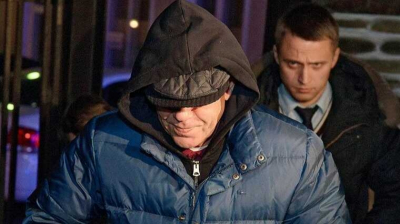




RISE Project found that Romania’s top judge helped acquit a robbery defendant and member of an organized crime group while she co-owned land with his uncle. The man later went on trial in a separate attempted murder case, and Savonea’s 2025 appointment triggered protests over alleged corruption in the justice system.
As Romania’s top judge faces mounting public pressure over her alleged leniency toward organized crime, a new investigation has revealed that she presided over the 2013 acquittal of a convicted robber, while co-owning real estate with the man’s uncle.
The findings by the RISE Project, an investigative journalism group and OCCRP partner in Romania, cast a harsh new light on Lia Savonea, who was appointed president of Romania’s High Court of Cassation and Justice in June 2025 and is a former president of the Superior Council of Magistracy and Bucharest Court of Appeal. Her elevation sparked widespread protests late last year, with demonstrators accusing her of shielding corrupt officials and crime syndicates.
The 2013 case centered on Sorin Raiciu, who had been sentenced to seven years in prison for a brazen 2008 robbery. Prosecutors said Raiciu and accomplices ambushed a businessman outside his Bucharest home, fleeing in a black BMW with a briefcase containing the equivalent of $23,000. Investigators systematically dismantled his alibis, leading to his initial conviction.
But upon appeal in December 2013, a judicial panel led by Savonea abruptly overturned the conviction, allowing Raiciu to walk free.
According to property and court records reviewed by RISE, Savonea and her husband had financial ties to the defendant’s family at the time. In 2006, the couple purchased a 2,500-square-meter plot of land in Chiajna, a town near Bucharest, alongside Florian Purcel—one of Raiciu’s uncles. The co-ownership lasted until the property was sold in 2018, encompassing the entire period of the trial and the appeal.
Another uncle of Raiciu, Marian Velicu, known locally as “Dede,” also featured prominently in the robbery case file. Investigators identified him as a conduit for messages meant to influence witnesses, RISE reported.
Cristi Danileț, a former judge and former member of Romania’s Superior Council of Magistracy, told reporters that the revelation raises questions about impartiality. If a judge knew the people involved in a case and maintained financial ties to their family, Danileț said that that judge had a clear duty to recuse himself.
Compounding the suspicions, reporters uncovered a bizarre administrative anomaly regarding the case: the acquittal exists in two entirely different versions. One version, featuring a specific set of legal reasoning, was logged into the court’s electronic system, while a substantially different version was placed in the physical case archive. Danileț and Daniela Panioglu, a former appellate judge, told RISE that such a discrepancy is virtually unprecedented and highly suspicious.
Raiciu, the acquitted defendant, did not stay out of the justice system for long. In 2020, prosecutors charged him and several associates with attacking rivals with guns and machetes in broad daylight in Chiajna. He and other men are currently on trial for attempted murder.
The RISE investigation adds fuel to a volatile political fire surrounding the nation’s judiciary. In November and December 2025, massive protests erupted in Bucharest and other Romanian cities, with demonstrators taking to the streets to explicitly oppose Savonea’s leadership of the High Court and denounce corruption within the judicial system.
Savonea has categorically denied the allegations of protecting corrupt figures. Meanwhile, Romania’s Superior Council of Magistrates has rushed to her defense, condemning the public backlash as a dangerous attack on judicial independence.
In a reply to the RISE Project, Lia Savonea dismissed all accusations against her and said that she acted according to the law. “I categorically reject any insinuation regarding the existence of unlawful conduct or any personal interest in connection with the mentioned case,” she wrote.